Grace Semaan
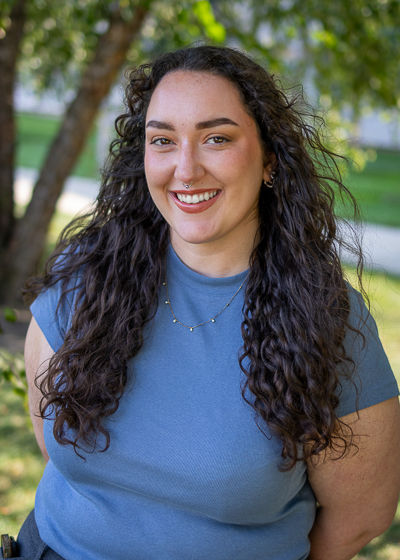
Grace Semaan is an MGI graduate student working in Jim Moran's Lab. These are her answers to the Micro Biography questions:
How and when did you become interested in the field(s) of microbiology, genetics, and/or immunology?
I became interested in microbiology after taking biochemistry in undergrad. I was fascinated by antimicrobial resistance and the efforts being made to develop antimicrobial peptides. That led me down a long microbial rabbit hole that eventually landed me a position in UW-Madison’s postbaccalaureate research education program (PREP). I spent a year after earning my chemistry degree gaining microbiology lab experience by working for 2 labs that studied different human pathogens. These valuable lab experiences solidified my interest in applying my chemistry knowledge to a microbiology lab for the advancement of interdisciplinary science.
Were there any particular people or events who were influential in your journey?
Absolutely! I’ve had so many influential mentors along my journey in academia and amazing research opportunities that helped forge my current path forward. During undergrad many faculty such as my research advisor, advisors from the Office of Multicultural Student Affairs, and my boss at the Women in STEM Center influenced my ability to succeed. The time they dedicated to training, meeting, and uplifting me set me up to succeed during my postbaccalaureate experience.
Coming from a smaller PUI (primarily undergraduate institution), I didn’t have many resources to turn to for pursuing a graduate degree. My time at UW-Madison opened my world up to a plethora of resources I never knew existed. The faculty who run the PREP program were instrumental in my development of grant writing skills, graduate application preparation, science communication, and so much more. Without their guidance and belief in my scientific abilities I’m not sure where I would be right now.
As a third-year PhD student in the MGI department, I can also say the administrative faculty of the MGI department are the reason I am still able to pursue a PhD. While dealing with various unforeseen circumstances and uncertain funding situations, they have all been there as a guiding voice of reason. Their care and attention to student needs is palpable and has made my PhD experience better than I could’ve imagined.
How did you come to be a part of this department?
During my post-baccalaureate program at UW-Madison I had the time and resources to apply to many different microbiology programs across the country. One of my advisors took me to a local conference on microbial pathogenesis (shoutout to MMPC!) before grad school applications were due and introduced me to people from many of the universities I had applied to. I specifically remember an interaction I had with an MSU MGI faculty member after the first day had concluded. They were so kind, respectful, and engaging in our conversation about my Listeria monocytogenes research that I truly felt like they cared. This was not something I experienced with every institution I applied to. Through the interview process and admitted students’ day, it was obvious that MGI had a collaborative and friendly community. That was a priority for me, and a huge reason why I chose MSU’s microbiology program.
What is your main role / research area right now and why is it important?
My main research area is an intersection of chemistry and microbiology. My lab focuses on stable isotope bio-geo-chemistry, with my project focusing more on the environmental microbiology of cyanobacteria. I study cyanobacteria isolated from harmful algal blooms across the great lakes to understand how different factors like population dynamics, nutrient availability, and temperature impact bloom occurrence. I am hoping to understand how nitrogen fixing cyanobacteria impact nutrient availability for non-nitrogen fixers, and how this nutrient cycling impacts harmful algal bloom occurrence. To do this, I am developing a method on a high-resolution mass spectrometer to look at the differences in Nitrogen stable isotope values found in the genetic material of isolated cyanobacteria. This area of environmental microbiology is important for keeping water sheds clean and free of toxins, ensuring ecosystem stability, and developing new mitigation strategies for harmful algal blooms.
How do you see your role / research evolving?
There are so many different aspects of harmful algal blooms that researchers haven’t been able to investigate yet, so I imagine this will help fit one piece into the puzzle. I would love to see the field expand into understanding trophic-level impacts of harmful algal blooms, using high-throughput genomics/sequencing to uncover changes in gene expression during bloom recurrences, and tease apart how nutrient cycling in an ecosystem impacts bloom recurrences. From the stable isotope perspective, it would be awesome to see the field begin to define fractionation factors of isotopes during high resolution mass spectrometry analysis. This would help those developing methods understand what their accuracy and precision is for obtained results. Additionally, advancements to the technology available in the field would aid in method development of identifying stable isotopes of interest in any system.
What types of activities are you involved in outside of work / research?
I love participating in my community. This can range from volunteering at outreach events to baking banana bread for my neighbors. I enjoy the outdoors, taking small hikes, and lounging in my hammock with a beautiful view. If I’m not outside, then I am probably trying a new recipe in the kitchen, dirtying my craft table with a fun new project, or travelling to a destination on my bucket list. No matter what I’m doing, I will also have generated the perfect music playlist to fit the vibe of the activity at hand.
What is next for you?
Within the next semester, I will be taking my comprehensive exam to gain candidacy status. After that, my plan is to keep making progress in my research while growing into my communities. I like serving on committees, engaging with student organizations, mentoring students, and participating in national scientific communities to make impactful changes and gain important professional skills. I enjoy being an active member across many communities and making connections as often as possible. There are incredibly diverse perspectives and paths within any community, and I plan to continue uncovering those in the spaces I occupy.
What do you see as your current career trajectory?
I am intrigued by the paths of scientific communication and science education. I see myself involved in various positions that require skills in scientific communication such as a textbook publisher, media coordinator of a national society or industry, museum curator, or a science advisor to a government official. If it involves taking advanced, nuanced, or niche science and communicating it to a broader audience – I’m your guy! While I still have a few years left before defending my thesis, I will continue practicing my scientific communication skills through media posts, conference presentations, and scientific outreach events!
Is there anything else you’d like to share?
The only other thing I’d like to share is that it’s ok to have an “unconventional” path to your career. The first time I applied to graduate school (without any resources or help) I didn’t get in. I thought my life was over since I didn’t have much of a plan after undergrad besides starting my graduate career, and I felt like an imposter amongst fellow classmates that had jobs lined up post-graduation. Instead of letting that fear take control of me, I worked within myself to let go of the things I cannot control and applied to other types of programs. Without this “failure” I would’ve never known about or applied to UW-Madison’s PREP program that gave me opportunities important for my success as a graduate student.
Everyone’s path in life is unique, so comparing your knowledge, self-worth, or achievements to those of your peers will not help you move forward. In the moments where comparison feels necessary, I encourage you to not compare but instead reflect on how much you have grown in a year, two years, etc. You may be surprised at how much you are able to accomplish when you start crediting yourself for it.
Lastly, don’t be afraid to step outside your comfort zone. Ask the question, send the email, introduce yourself to a stranger. You never know what types of opportunities you restrict yourself from by not participating in your community. Like Wayne Gretzky said, “you miss 100% of the shots you don’t take,” so don’t be afraid to take yours!