Dr. Robert Uffen
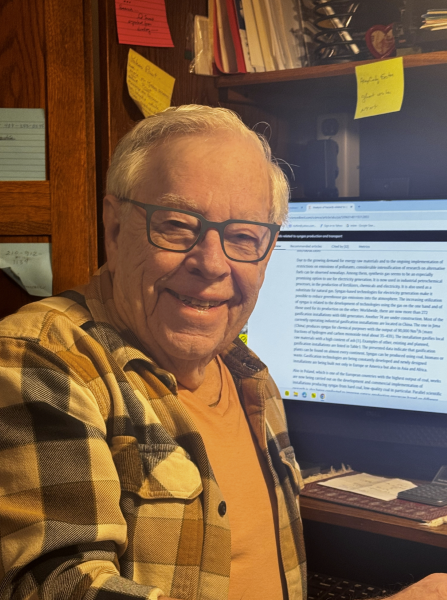
Dr. Robert Uffen is Professor Emeritus of Microbiology at Michigan State. He wrote the following for us, incorporating his answers to the Micro Biography questions:
My educational experience began in Santa Paula, a small California citrus-growing town of 10,000 people and one high school of 600. I lived there, worked, studied, and finally, as the president and valedictorian of my senior high school class, I received a small scholarship to the University of California at Berkeley. I was gone from my small town.
Entering the Berkeley campus, I thought I would become a concert pianist, since, in my small town, I had played for ladies’ clubs and music appreciation classes during my youth. But in high school, I also had good experiences in the sciences and humanities and so, confronted with a long list of study options, I decided to follow course recommendations in the university premed curriculum. Underlying this decision was also my plan, devised years before with Kurt Meissner, my buddy and our high school International Exchange student from Austria, that I would remain at Berkeley for two years and then join him in medical school in Vienna for a year and then return to Berkeley for my junior year. This was all possible in Vienna, since Kurt’s father was a well-known surgeon and helped arrange my entry into medical school there. At the end of a year of Viennese medicine, I returned to Berkeley, as planned, now majoring in physiology, a discipline that I soon found uninteresting, and quickly declared a new major in German. Later that year, I also applied to medical school and was accepted at Stanford University where I went on to pursue a full course load in preclinical medicine as well as courses leading to a BA in German.
As a medical student at Stanford, I had amazing experiences but nevertheless decided that I wasn’t suited for life as a physician and, maintaining my interest in language, withdrew from medicine to complete the BA in German. The same year, I applied for and was awarded a National Defense Education Act scholarship to work toward a doctorate in German at the University of Massachusetts. At UMass I began to have second thoughts about a PhD in German. At that time, I was also very interested in joining the United Nations as a simultaneous translator. With this idea in mind, I acted to shorten my time in German study and earned an MA degree in the language while beginning to think of other options I had found interesting along my way.
I recalled really exciting classes and professors I had experienced, especially in medical school at Stanford. I had studied biochemistry with Arthur Kornberg, medical genetics with Joshua Lederberg (both Noble Prize winners), but of all my different classes in medical school, microbiology interested me most, so I withdrew from my NDEA scholarship in language, was awarded a National Institute of Heath scholarship, became a PhD student with Ercole Canale-Parola at the University of Massachusetts in the Department of Microbiology, and did research on the role of pigments in bacteria, specifically pulcherriminic acid. I received a PhD research degree and a post-doctoral NIH scholarship in microbiology at the University of Illinois, Urbana-Champaign, with Ralph S. Wolfe.
The University of Illinois was a basic research paradise where I was given the post-doc to investigate the use of carbon monoxide by Methanosarsina barkerei reported by Theresa Stadtman in a review paper. At Champaign-Urbana, I was not able to isolate any methanogen that metabolized CO but, instead, isolated Rhodopseudomonas gelatinosis that grew with CO anaerobically without light and reduced water with the release of hydrogen gas according to the equation CO+ H20 = CO2 + H2 at room temperature. This was a first-time discovery and was published in the Proceedings of the National Academy of Science. In addition, I was privileged to work with Ralph S. Wolfe, Robert E. Hungate, Marvin P. Bryant, and Carl R. Woese , all at the University of Illinois when their collective research created a unique, major new group of microbes, the Archaebacteria within the animal and plant kingdom.
I was now doing what I definitely wanted to do and, when I chose to join the university research/teaching community in the Department of Microbiology and Public Health at Michigan State University, I was definitely where I wanted to be. At MSU I worked and taught both undergraduate and graduate research PhD students for 26 years.
As a research scientist, although I had a strong background in medical-based work, my main interest was and, even in retirement, continues to be, environmental microbial research. The discovery that a bacterium can grow with CO as its sole energy source and release hydrogen gas directly from water presents water as an infinite resource for energy on earth. Even considering my early discovery, still a major energy need remains to resolve the microbial biochemical/molecular-based pathway to extract hydrogen gas with carbon monoxide at ambient temperature from water as an infinite earth hydrogen gas energy resource.
At the end of my active teaching and research career, I still value most my contact with people, with students, researchers, and others interested in the future of our fragile planet, with our discussions, arguments and agreements, and personal interactions both inside and outside the academic environment. Today, I still track progress in microbial research, in federal research policy, and very much value art and music and, now too, my own return to music.
To those contemplating new careers in whatever field, and this includes my own grandchildren, here’s my honest advice: listen to all the well-meaning ideas others offer to you but, finally, know that your future is your own decision to find. Discover what you like best, what you feel best doing, what satisfies you, and just do it. You have accomplished a lot already and are capable of more. Try new ideas. Be confident and you will succeed.