MGI 301 teaches students to think like scientists
For many college students, science classes follow a familiar routine: attend a lecture, take notes and complete the most challenging assignments later. On your own.
That’s not how students experience MGI 301: Introductory Microbiology.
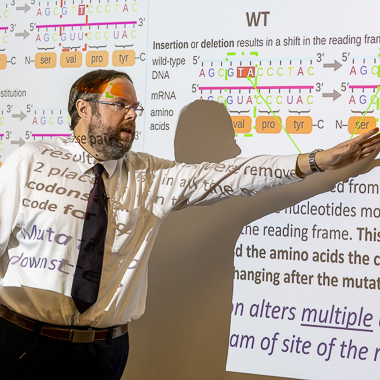
Instead of spending class time listening to lectures, students arrive having already reviewed the material through online videos and assigned readings. That leaves them free to spend class analyzing data, solving problems and learning how to think like a scientist.
“We’re not here just to teach you microbiology,” said Assistant Professor Phillip Delekta, of Michigan State University’s Department of Microbiology, Genetics, & Immunology, or MGI, who coordinates the course. “Certainly, we’re going to do that. But we want to develop you as scientists and physicians.”
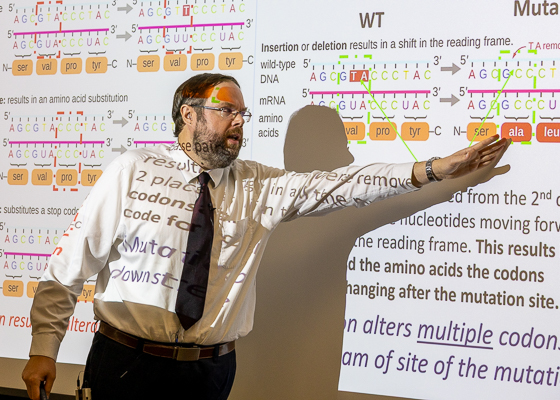
Each semester, MGI 301 serves up to 500 students from across Michigan State University. While many are pursuing careers in medicine or other health professions, students come from nearly every undergraduate college at MSU, including engineering, natural resources and business. For many, the course is their first in-depth introduction to microbial science.
Students learn core concepts including bacterial physiology, gene expression and the molecular basis of disease. But the way they learn to use that knowledge is central to the course.
Delekta redesigned MGI 301 around a flipped classroom model paired with active learning because he wanted students to spend more time practicing the part of science that can be difficult to learn on their own: how to apply what they know.
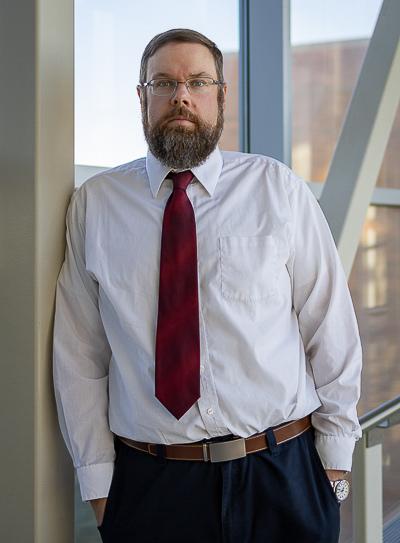
“The hardest part of teaching and mentoring future scientists and physicians is how to apply content,” Delekta said. “We’re here to help you do the hard part.”
Classroom activities ask students to interpret data, evaluate evidence and explain their reasoning as they work through questions modeled after real scientific problems. Rather than being given a path to the answer, students must decide what information matters and how to use it.
For students accustomed to traditional lectures and exams, that approach can be challenging. But it more closely resembles the kind of problem-solving they will be asked to do as science professionals.
“It’s like learning a sport,” Delekta said. “You don’t just draw how to shoot a basketball on the whiteboard. You talk students through it, you demonstrate it, you do it with them and then you expect them to do it on their own.”
A team approach to teaching
One of the course's greatest strengths is its layered teaching team.
While Delekta serves as course coordinator, MGI 301 is a collaborative effort. MGI Associate Professors Jonathan Hardy and Neal Hammer co-teach the course, contributing lectures and course content and working closely with Delekta to continually refine the curriculum.
“They’re critical to managing a large course and improving student success,” Delekta said.
The instructional team that also includes graduate teaching assistants, or GTAs, and undergraduate learning assistants, or ULAs. As students work through problems in small groups during class, they can turn to members of the instructional team for guidance.
Each member of the team brings a different perspective. Faculty members contribute subject expertise and teaching experience, while graduate students are closer to the undergraduate experience themselves.
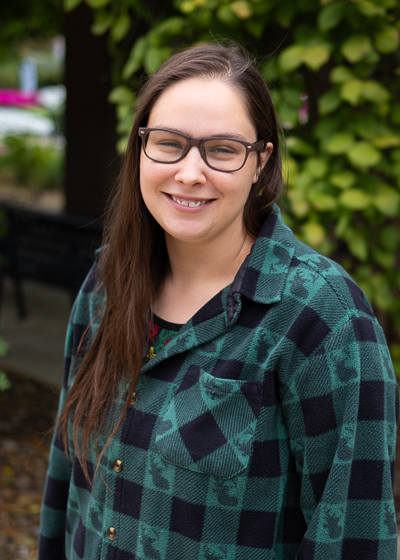
“We’re just a step ahead of them,” said MGI doctoral student Heather Murdoch, who served as a GTA for the course. “I think students can look at us and see themselves getting to where we are someday.”
That position also shapes how GTAs teach. Murdoch said her role was not to simply give students the answer when they struggled with a problem. Instead, she learned to ask questions that would help them reason their way toward it.
ULAs are closer still. Many return to the classroom after excelling in MGI 301 themselves, giving them firsthand knowledge of both the material and the student experience.
“There’s a certain comfort level that the students have with ULAs that they don’t really have with me or even a graduate student,” Delekta said.
Dylan Luce, who took MGI 301 as a sophomore and later spent four semesters as a ULA, experienced that relationship from the other side. When students worried about keeping up with the course alongside their other responsibilities, he could speak from experience.
“I was there,” Luce said. “I get what it’s like to have a million classes plus extracurriculars and research opportunities.”
That shared experience helped Luce build trust with students, whether he was offering study strategies, drawing diagrams to explain a concept or helping them understand why something they were learning mattered beyond the immediate assignment.
For Delekta, the ULAs are much more than classroom assistants.
“They are some of the best students at MSU,” he said. “They really make you proud to be an alumnus of this university.”
The relationships can extend beyond the classroom. Delekta works closely with ULAs as they consider their own futures, offering career advice, connecting them with research opportunities and writing letters of recommendation for graduate and professional schools.
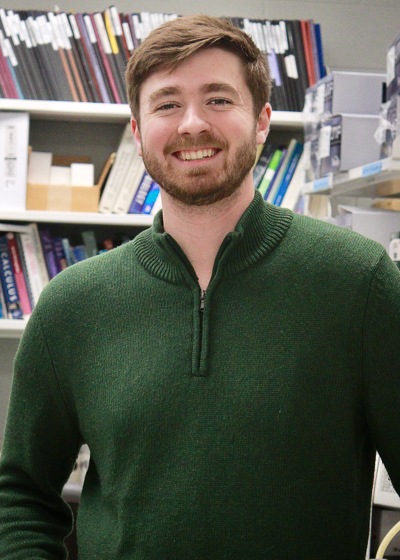
Luce found himself becoming a mentor as well. He stayed in contact with some former students, advising them as they looked for research laboratories or considered graduate school. Serving as a ULA also changed how he thought about his own future. Now a Ph.D. student at the University of Pennsylvania, Luce plans to pursue a career in academia and said MGI 301 helped him understand that being a professor involves not only research, but also teaching, mentoring and communicating science.
“I’m thankful to 301 or else I wouldn’t have known that I like teaching and mentoring like that,” Luce said.
Preparing future educators
For GTAs in particular, MGI 301 serves as a training ground for careers involving teaching and science education.
Rather than assigning GTAs only routine teaching responsibilities, Delekta mentors them as they develop lectures, write learning objectives, revise course materials and think critically about how students learn. The experience gives graduate students opportunities to build teaching portfolios and, in some cases, pursue questions that emerge from their own experiences in the classroom.
That is what happened for Murdoch.
As a GTA, she noticed that some students struggled with the independence required by the flipped classroom. Because students encounter much of the foundational material before coming to class, they have to decide for themselves when and how to complete that work. Murdoch began wondering whether time management, rather than the microbiology itself, might be contributing to some students’ difficulties.
That observation eventually became an education research project. Murdoch developed an intervention to help students think deliberately about how they organized their time, then examined their time-management practices alongside measures of their performance in the course.
The project also changed Murdoch’s own trajectory. Although she had enjoyed teaching before working with MGI 301, she said the experience of conducting education research helped her realize that she wanted to make it part of her career.
“I knew I was good at it, but I wasn’t sure if I was actually going to go into it as a profession,” Murdoch said. “It was really this program, and then this project, that made me realize that this is what I want to do for the rest of my life.”
Murdoch hopes to get a postdoctoral position related to education research after completing her Ph.D. She credits Delekta not only with giving her room to explore that interest, but also with helping her understand how to turn it into a career.
“He puts a lot of thought into mentoring me, and I can tell that he really cares,” Murdoch said. “He has no idea what he’s done for me.”
Other education research projects have grown out of MGI 301 as well, exploring questions such as how well students retain material from prerequisite courses and how different academic backgrounds affect performance. Other work has explored the use of artificial intelligence as a learning tool.
Together, those projects make the course a place where undergraduate and graduate students can participate in another kind of scientific inquiry: studying how students learn.
A culture of teaching
Just as students are asked to evaluate evidence and reconsider their conclusions, the instructors continually evaluate the course itself.
Each week, members of the instructional team debrief about what happened in the classroom: what worked, what didn’t, where students struggled and what could be changed the next time the material is taught. With hundreds of students representing different majors, academic backgrounds, and levels of preparation, those conversations help the course respond to what instructors are seeing in real time.
“The course is not revolution as much as constant evolution,” Delekta said.
Delekta credits that approach in part to a broader culture of teaching within MGI. Faculty members are routinely given the opportunity to exchange ideas about teaching strategies, contribute to shared course materials, discuss challenges, and make space for conversations about how to improve student learning.
Ultimately, Delekta hopes students leave the course prepared to do more than simply recall facts they have learned. By working through complex problems and learning to apply their knowledge, they develop skills they can carry into advanced coursework, research laboratories, medical training, and careers beyond microbiology.