NSF Graduate Research Fellowships awarded to three graduate students in MGI labs
Three graduate students working in laboratories in Michigan State University’s Department of Microbiology, Genetics, & Immunology, or MGI, have been awarded prestigious National Science Foundation Graduate Research Fellowships, recognizing their potential as emerging leaders in science and engineering.
These fellowships support outstanding graduate students pursuing research-based graduate degrees in STEM disciplines by providing three years of support, including funding for research, training, and professional development.
Elena Renshaw
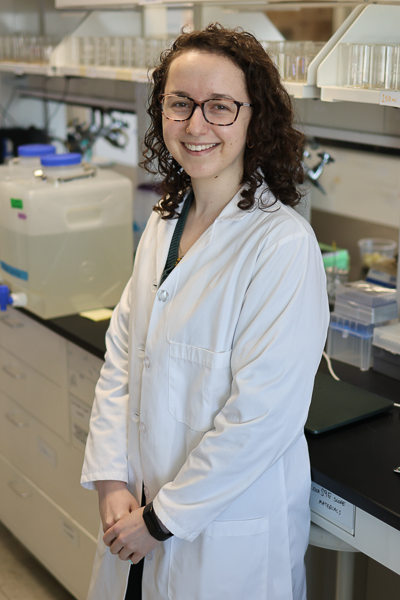
Elena Renshaw, a graduate student in Integrative Biology, or IBIO, and Ecology, Evolution, and Behavior, works in MGI Assistant Professor Nina Wale’s lab, where her research focuses on understanding the mechanisms that drive heritable variation in pathogen resistance in invertebrates. Using the model system of the water flea Daphnia magna and the bacterium Pasteuria ramosa, she investigates how hosts defend themselves against infection.
Renshaw's work focuses on both immune cells that help attack invading pathogens and strategies that limit the resources those pathogens need to survive. While the Daphnia–Pasteuria system has long been used to understand the likelihood of infection, Renshaw’s research aims to better explain what happens after infection begins—why some hosts are able to control disease more effectively than others. This work will help expand understanding of immune defenses across a wide range of biological systems.
“Elena came to MSU already armed with an interdisciplinary toolkit and an intimate knowledge of the little zooplankton hosts on which my lab works,” said Wale. “These organisms have been used to study evolution and host‑parasite interactions at the population scale for a long time, but not much is known about how individual hosts defend themselves against infection. Elena's research will address this critical knowledge gap and could, ultimately, help us to understand how host defenses against infections evolve.”
“Winning the fellowship is incredible because it provides me with security as well
as a sense of confidence and determination as I move forward with my work,” said Renshaw.
Alice Walker
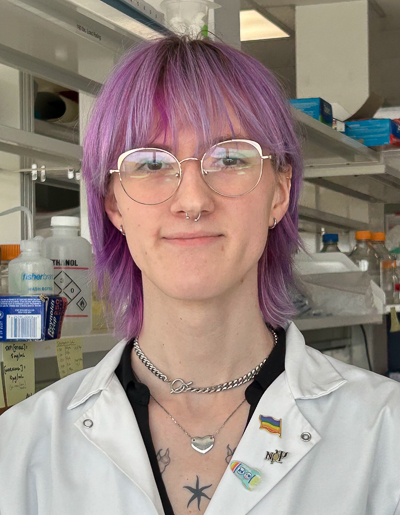
Alice Walker works in the laboratory of MGI Assistant Professor Elizabeth Heath‑Heckman and will begin the IBIO Ph.D. program in August. Her research centers on the squid light organ, and her fellowship project examines how symbiosis shapes neuronal function and neurodevelopment in this system.
Heath‑Heckman praised Walker’s impact in the lab, noting her strong contributions, creativity, and dedication.
“Alice has been doing amazing work in my lab in characterizing the nervous system of the squid light organ.” said Heath-Heckman. “Before joining my lab, she was an undergraduate at Tulane and then worked as a technician there. She is hardworking, creative, and an amazing artist as well.”
“Being given the opportunity to continue my education and do science that I truly enjoy while feeling financially secure is a huge privilege,” said Walker. “As a first-generation PhD student who didn't know what the GRFP was a year ago, I'm just beyond grateful for all of the support I've gotten from my family, friends, and lab members to help me get here.”
Bryce Waller

Bryce Waller is an MGI graduate student who works in MGI Associate Professor Greg Bonito’s lab.
Waller’s work focuses on developing sustainable biomaterials using fungi, with the goal of reducing environmental impacts associated with industrial production. His research aims to create renewable, biodegradable, low‑carbon materials that bridge microbiology and materials science, offering scalable alternatives for a more sustainable future.
“Products that I am developing take advantage of the natural ability of fungi to decompose, where industrial or agricultural byproducts can be used to turn refuse into new materials,” explained Waller.
“Bryce is passionate about microbiology and mycology and he has a creative vision of sustainability that incorporates microbial biotechnology,” said Bonito. “Through his research, Bryce is investigating ways to use fungi and bacteria in bio-composts for new classes of materials that include bio-adhesives, building materials, textiles and fabrics.”
“Being awarded the GRFP is incredibly meaningful to me,” said Waller. “I recognize that in this unstable time for academic funding, that getting awarded this fellowship is a great honor and privilege. I plan to use my time and this funding wisely as many students do not have the opportunity that I have.”